
Reliable IT support for businesses with 15+ employees across Rockville and the DMV, guided by experts who actually know their stuff.
Enjoy your first month free with zero onboarding fees.
Even the best backup strategy leaves four distinct gaps that ransomware can exploit to disrupt your business. Relying on backup alone means attackers still have ways to force downtime, data loss, or ransom payments.
When ransomware hits a business with no real defense plan, the costs show up fast: systems go dark, staff sit idle, and the ransom demand lands before anyone has time to think. Ransomware protection is often treated as a safety net for exactly this moment, but the reality is more complicated.
Attackers don't just encrypt files—they look for weak spots in your defenses, even when you think you've covered the basics. That search doesn't stop at your backups. Even with reliable systems in place, businesses can still face downtime, data loss, or ransom demands if attackers find other ways in, because the most effective ransomware attacks don't rely on just one tactic. They exploit several points of failure at once.
A strong backup plan is essential, but it's not the only answer, since backups protect your data without protecting the process of getting back to work. Understanding how ransomware attacks work helps you spot the gaps that backups alone can't close. If you're responsible for IT security, knowing these failure points is the first step to building a more complete defense.

Many businesses trust their backup systems to save them if ransomware strikes, and that trust makes sense—backups are a core part of any disaster recovery plan. But attackers know this too, and they've adapted their methods to target more than just your files.
When ransomware hits, it often goes after backup data as well as primary systems. Some strains are built to search out backup files and encrypt or delete them before anyone notices a problem, which means that if your backup system shares a network with your main systems, it shares the risk.
Even when backups survive, restoring everything takes time, and during that window your business may be unable to operate. That gap is exactly where pressure to pay the ransom builds, because attackers count on the disruption to force your hand.
The lesson is clear: backups are necessary, but they are not a complete solution. The other ways ransomware can bypass or undermine recovery efforts deserve just as much attention.
A backup plan, even when carefully managed, leaves certain doors open. Below are four distinct weak spots ransomware can target, each one a separate risk to your business.
If your backups are stored on the same network as your main systems, ransomware can reach them there too. Attackers often look for connected drives or backup appliances and encrypt those as well, making recovery impossible without paying the ransom.
Some ransomware sits quietly for days or weeks before activating, and during that stretch it can infect backups right alongside live data. By the time anyone notices, the most recent backups may already be compromised.
Attackers often steal admin credentials to gain access to backup management consoles, and once inside, those privileges let them delete or alter backups, disable protection features, or reshape backup schedules to suit their own timeline.
Modern ransomware doesn't just encrypt files—it can steal sensitive data first. Attackers then threaten to leak that information unless you pay, even when your backups are intact, which keeps the pressure on regardless of how strong your recovery options are.
Knowing where ransomware can slip through is only the first step; closing those gaps takes a specific set of actions.
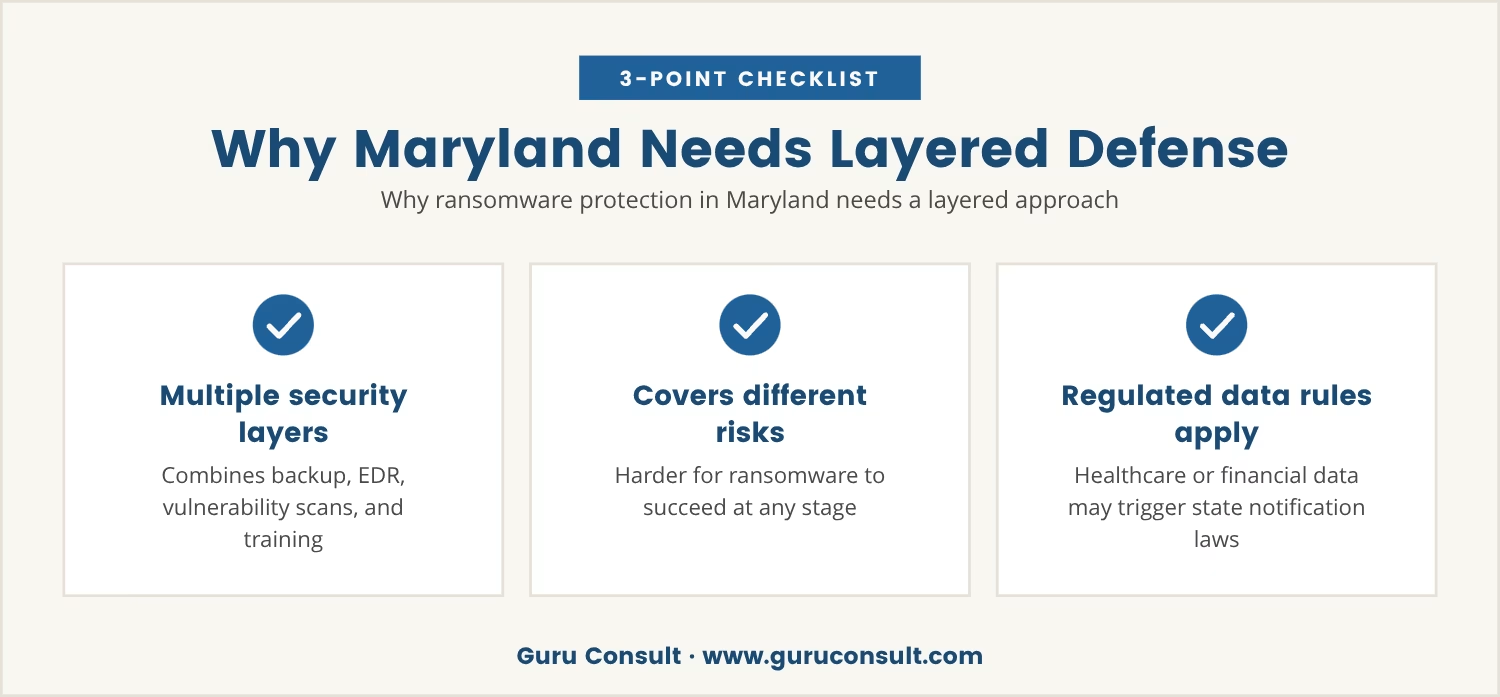
Businesses in Maryland face the same ransomware threats as those anywhere else, but local regulations and industry standards often add extra pressure to protect sensitive data. That added pressure means relying on a single line of defense—like backup alone—doesn't meet the expectations of most compliance frameworks.
A layered approach combines backup best practices with other security measures, including endpoint detection and response (EDR), regular vulnerability scans, and employee training to spot phishing attempts. Each layer covers a different risk, which makes it harder for ransomware to succeed anywhere along the chain.
If your business handles regulated data, such as healthcare or financial records, state-specific rules for incident response and data breach notification likely apply as well. Understanding these requirements helps you build a plan that protects both your data and your reputation.
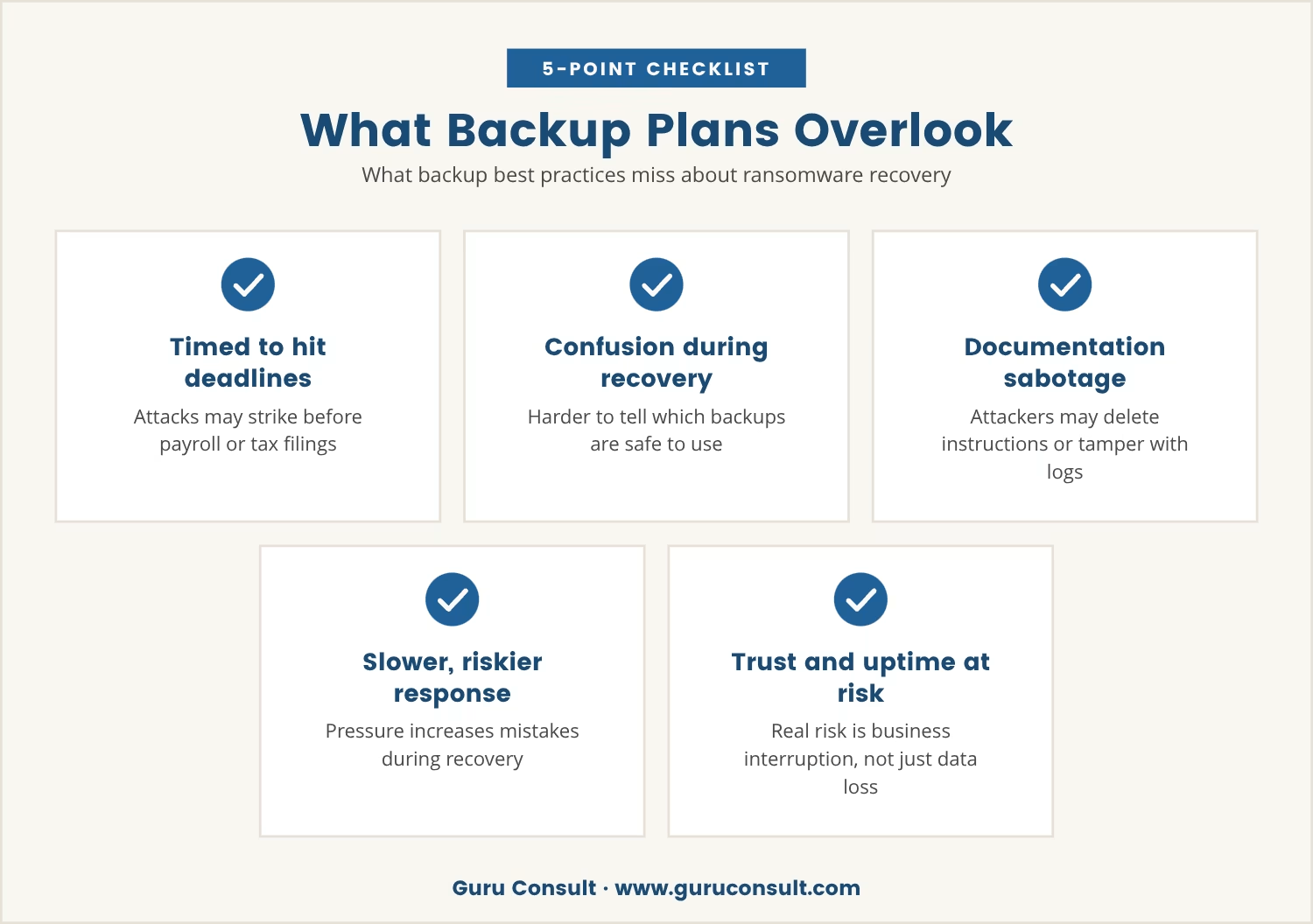
Backup best practices focus on keeping copies of your data safe and available, but ransomware attacks are designed to disrupt more than just your files—they target your ability to recover quickly and quietly.
Some attacks are timed to strike just before a critical deadline, such as payroll or tax filings, which turns a technical problem into a business emergency overnight. Others are built to sow confusion during the recovery process itself, making it harder to know which backups are safe to use.
Attackers may also go after your backup documentation directly, deleting recovery instructions or tampering with logs. The result is a slower response and a higher chance of mistakes made under pressure.
The real risk, then, is not just data loss, but business interruption and loss of trust. A backup plan that doesn't account for these tactics leaves your business exposed.
A strong ransomware prevention plan is more than a checklist, and a few warning signs tend to show up wherever the current approach is falling short.
Understanding where ransomware can bypass backup best practices changes how you approach cybersecurity, since each failure point is a reminder that attackers are always looking for new ways in.
A resilient defense combines strong backups with proactive monitoring, limited admin access, and regular testing, and it also prepares you for the possibility of data leaks and extortion, not just file encryption.
Closing these gaps reduces the risk of business disruption and protects your reputation along with it. The goal is not just to recover from an attack, but to make it as hard as possible for ransomware to succeed in the first place.

Many businesses with 15 to 200 employees trust their backup strategy, but still worry about ransomware slipping through the cracks. At Guru Consult, we understand how unsettling it is to realize that a single gap could put your data or operations at risk.
If you want to see how we approach ransomware defense beyond just backup, or want a second opinion on your current setup, our team is ready to talk.
We’ll buy out your current IT contract for up to 3 months, making it easier to move your ransomware protection to a more secure provider.
Use advanced ransomware detection tools that monitor for unusual file changes, rapid encryption activity, or unexpected network traffic. Regularly scan endpoints for signs of malware and set up alerts for suspicious behavior. Training employees to recognize phishing emails also helps catch attacks before they spread.
Effective solutions combine reliable backup systems, endpoint protection, and multi-factor authentication. Antivirus software with real-time ransomware prevention features adds another layer. Pairing these tools with network segmentation and regular vulnerability assessments blocks ransomware at multiple points rather than just one.
Relying solely on backup leaves you exposed to attacks that target backup systems directly or use tactics like data exfiltration. If attackers compromise your backups or threaten to leak sensitive information, you may have no safe way to recover. A layered approach is safer.
Double extortion means attackers not only encrypt your data but also steal it, then threaten to publish or sell the information unless you pay the ransom. This raises the stakes, since even businesses with good backups can face reputational and legal risks if sensitive data is leaked.
Start by isolating backups and using strong, unique passwords for all admin accounts. Enable MFA wherever possible and keep your antivirus software updated. Regularly test your backup restores and review your incident response plan to make sure everyone knows what to do if an attack occurs.

Jason Huebner is the President of GURU and an eleven-year veteran of the company, having risen through the ranks by consistently delivering results and building strong relationships.
Reliable IT support for businesses with 15+ employees across Rockville and the DMV, guided by experts who actually know their stuff.
Enjoy your first month free with zero onboarding fees.