




Reliable IT support for businesses with 15+ employees across Rockville and the DMV, guided by experts who actually know their stuff.
Enjoy your first month free with zero onboarding fees.

Cyber insurance policies always divide coverage into five separate categories, but buyers almost never see them listed together. Knowing these categories up front lets you spot what’s missing before you sign, not after a claim is denied.
A cyber insurance policy rarely gets built or sold as one simple product. Instead, insurers stitch together several distinct types of coverage, and the gaps between them are where most businesses get hurt. Premiums have grown by 74% in just one year, a jump that shows how seriously companies now take digital threats. Yet that climbing cost rarely comes with a clear view of what's actually being bought, since the categories inside a policy are seldom laid out side by side.
That lack of transparency has a direct consequence: it becomes easy to miss what's covered and what's quietly excluded. For a business owner, the difference between a claim that gets paid and a cost that lands squarely on the company often comes down to whether those hidden categories were ever understood. Most people only discover the gap after an incident has already happened, at the exact moment when the policy can no longer be changed.

Most business owners assume insurance will simply step in once a cyber attack hits. The reality is messier, because policies are written in dense legal language, and the fine print is where the real limits of protection usually hide.
A single incident can trigger costs across several fronts at once, which is exactly where thin coverage gets exposed. A data breach, for instance, might generate legal fees, customer notification costs, and system repair bills all at the same time, and few policies cover every one of those expenses in full.
That overlap is precisely why the underlying structure of cyber insurance deserves scrutiny. Seeing the categories laid out side by side makes it possible to spot which risks are actually funded, whereas skipping that step risks signing off on a policy with a blind spot that happens to sit right over the company's biggest exposure.
Every cyber insurance policy sorts its protection into five main categories, whether or not an insurer ever shows them together. Walking through each one separately makes it far easier to see what is genuinely included and what has quietly been left out.
This category pays for the direct hit a business takes after a cyber incident. It typically covers data recovery, system repairs, and income lost to business interruption.
Third-party coverage steps in when someone else sues the business over a cyber event. It handles legal fees, settlements, and regulatory fines tied to harm caused to others.
This piece covers costs tied to extortion attempts, including ransom payments and the experts hired to negotiate or restore access. Coverage here is far from universal, and where it exists, strict limits are common.
Data breach coverage funds customer notifications, credit monitoring, and public relations management after an exposure. These costs escalate quickly once personal information is involved.
This category covers the expense of responding to government investigations or defending against lawsuits connected to a cyber incident. Depending on the policy, it may also pay fines or penalties.
Any one of these five categories can be present in a policy or missing from it entirely, and no label on the cover page will say which. Lining them up side by side is the only reliable way to find out.
Having all five categories present doesn't mean the coverage is complete, since most policies still carry exclusions that catch buyers off guard. Knowing these in advance turns a nasty surprise into a manageable planning question.
None of these exclusions tend to appear in sales materials, so finding them means reading the policy wording closely or pressing a broker for specifics.
A business operating in Maryland works within the same five-category structure as anywhere else, but state law shapes how claims actually play out once filed. Maryland's own data breach notification rules, for one, can add cost on top of whatever the policy was built to handle.
That added cost is worth checking for directly: does the data breach response category in a given policy cover every step Maryland law requires? If it falls short, the gap becomes the business's own expense, a risk that weighs especially heavily on small business owners without a legal team on call.
Before signing any cyber insurance policy, ask the broker to lay out the five coverage categories side by side. That single request makes missing pieces far easier to spot.
A short list of questions keeps the review focused:
Clear answers at this stage head off expensive surprises later.
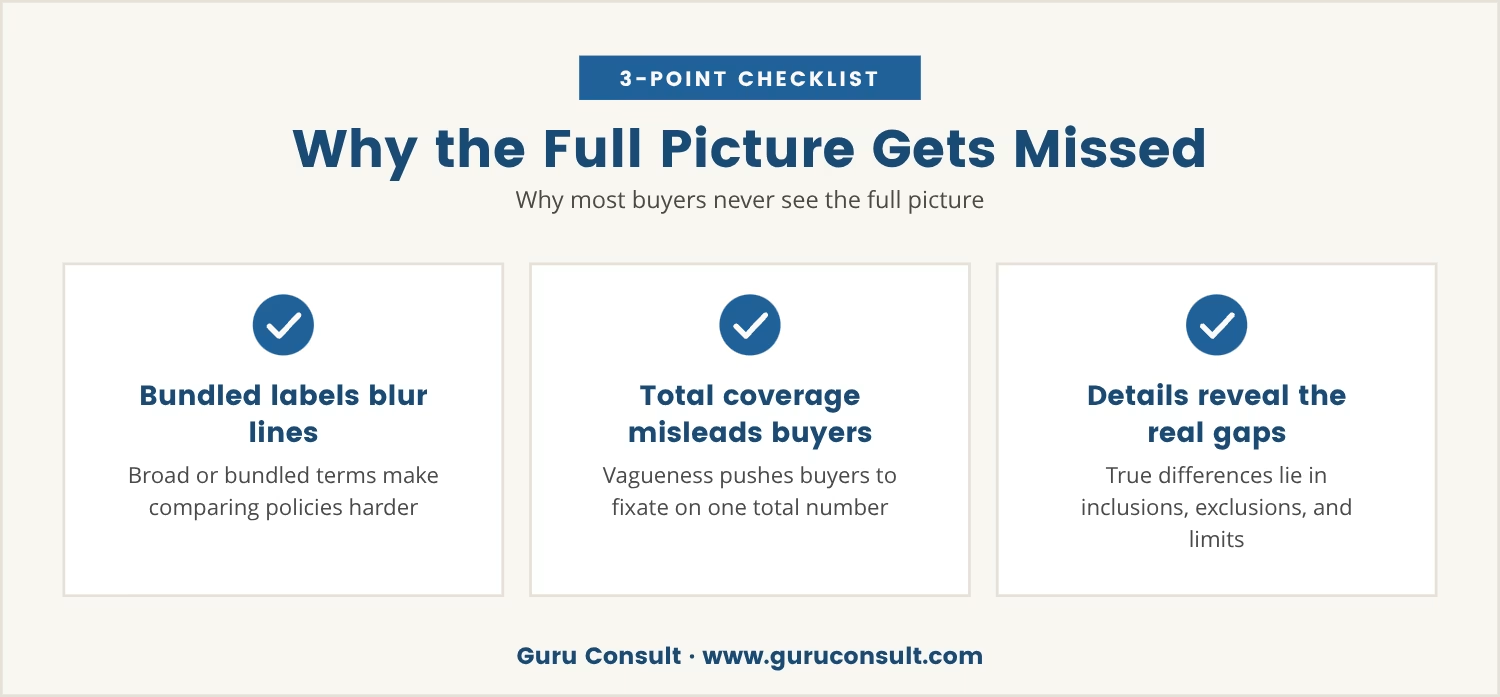
Insurers rarely present all five categories as a set. More often, broad terms or bundled labels blur the lines between them, which makes comparing two policies or two companies' offerings far harder than it should be.
That vagueness pushes many buyers toward a single number, the total coverage amount, as though it told the whole story. The real difference sits in the details underneath it: what's included, what's excluded, and exactly where the limits fall. Digging into that detail before signing is what actually pays off.
Worth asking directly: does the current policy clearly show which costs it would cover if a cyber incident happened tomorrow?
Seeing the five hidden categories of cyber insurance clearly is the most reliable way to keep a business from absorbing costs it assumed were covered. Lined up side by side, missing coverage becomes visible early enough to request changes before signing rather than after.
Most businesses only discover an exclusion once a claim has already been filed, at which point the policy can no longer be fixed. Reviewing these categories now, while there's still room to negotiate, is what prevents that scramble later.

Many businesses with 15 to 200 employees find themselves unsure if their cyber insurance truly covers every risk. At Guru Consult, we see how easy it is to overlook the fine print until a claim brings it to light.
If you want to see how your current policy stacks up or want a second opinion, we invite you to talk with us about your coverage. Let’s make sure you’re protected where it matters most.
We’ll buy out your current IT contract for up to 3 months if you qualify, making it easier to move your coverage to a plan that fits your real risks.
First-party coverage pays for a business's own direct losses after a cyber incident, such as data recovery or lost income. Third-party coverage applies when someone else sues the business because its systems or actions caused them harm.
Some policies include social engineering coverage, though many require it to be added as a separate option. Checking whether a policy specifically lists this threat, along with any limits or exclusions attached, is worth doing before relying on it.
Compare the policy's list of covered events against the five main categories above to see where the overlap stops. Any cyber incident type that isn't clearly listed is worth raising with a broker or addressing with added coverage.
Most policies restore systems to their prior state rather than funding improvements beyond it. Any new security features added after an incident are typically an out-of-pocket cost.
Small business owners in Maryland should confirm their policy covers every state-required data breach response step, including customer notifications and legal costs tied to local regulations. Where a policy stays silent on Maryland's specific rules, asking the broker how those costs would be handled is the next step.

Jason Huebner is the President of GURU and an eleven-year veteran of the company, having risen through the ranks by consistently delivering results and building strong relationships.
Reliable IT support for businesses with 15+ employees across Rockville and the DMV, guided by experts who actually know their stuff.
Enjoy your first month free with zero onboarding fees.