



Reliable IT support for businesses with 15+ employees across Rockville and the DMV, guided by experts who actually know their stuff.
Enjoy your first month free with zero onboarding fees.

Applying the same security standard to every type of business data leaves sensitive records exposed and wastes resources on low-risk information. Each data type requires its own level of protection, and failing to recognize this is a common cause of security failures.
A locked front door does nothing if a side window stays open, and that's how most data security programs fail: one blanket policy gets applied to every file, regardless of what that file actually holds.
Spreadsheets of marketing copy sit behind the same wall as Social Security numbers, so the wall ends up both too high in places that don't matter and too low where it counts.
That mismatch is the real finding here: identical security measures across every data type leave exploitable gaps while still driving up cost, since money spent padding low-risk files is money not spent hardening the ones attackers actually want.
Locking down files and running antivirus software is only the visible layer of data security; underneath it has to sit a judgment call about which information carries real value and real risk. Once that judgment is made, the choice of tools and strategies follows naturally, and the business keeps running instead of grinding to a halt after one bad incident.
Many businesses in Maryland face exactly this uncertainty, unsure which records deserve the strictest controls, and the cost of guessing wrong can be severe.

A single security standard applied everywhere looks efficient on paper, since one policy is simpler to manage than ten. But that simplicity ignores a basic fact: not all data carries the same risk or the same value.
Because the policy doesn't discriminate, money flows toward protecting information that was never sensitive to begin with. Meanwhile the data that actually matters sits under the same defenses as everything else, no better shielded than a routine internal memo.
Consider basic internal documents stacked against customer payment records or employee Social Security numbers. If both sit behind identical tools, attackers have an easier path to the records worth stealing, and the security budget gets stretched thin trying to cover ground that didn't need covering.
That gap between risk and protection is one of the main reasons businesses suffer data breaches in the first place. Attackers go looking for the weakest link, and a uniform approach, by design, leaves those links standing.
Every business holds a mix of information, and the mix is the point: none of it is equally sensitive, so none of it should be defended identically. Building real data security strategy starts with naming what's actually in the pile.
Some of it is public, some confidential, some bound by regulation, and each category carries its own fallout if it's lost, stolen, or exposed. Seeing those differences clearly is what makes targeted, rather than blanket, security possible.
What follows are the four main types of data a business is likely to hold, and why each calls for its own handling.
Public data is the material meant to be shared openly, like marketing materials or published reports, so losing it does little direct harm. Still, attackers can repurpose it for social engineering or phishing, which is why basic security tools and routine monitoring remain worthwhile here.
Internal data is what moves inside the company: memos, project plans, meeting notes. Exposure here could hand competitors an edge or disrupt operations, so access controls paired with employee training keep it contained without adding unnecessary complexity.
Confidential data covers business secrets, contracts, and financial records, and a leak in this category causes real financial or reputational damage. That higher stake is why encryption, strict access policies, and regular audits belong here.
Regulated data falls under laws like the General Data Protection Regulation or the payment card industry data security standard, covering personal data, payment information, and health records. Mishandling it brings legal penalties and lost customer trust alongside the breach itself, so specialized security solutions, compliance checks, and detailed monitoring aren't optional extras for this group.
Businesses in Maryland answer to both federal and state rules once sensitive information is involved, and state law can require notifying affected individuals when a breach exposes personal information. Skipping that step doesn't just risk fines; it costs the trust of customers and partners who expected better. Any business collecting or storing customer data needs to know precisely which regulations apply and confirm its defenses actually meet them.
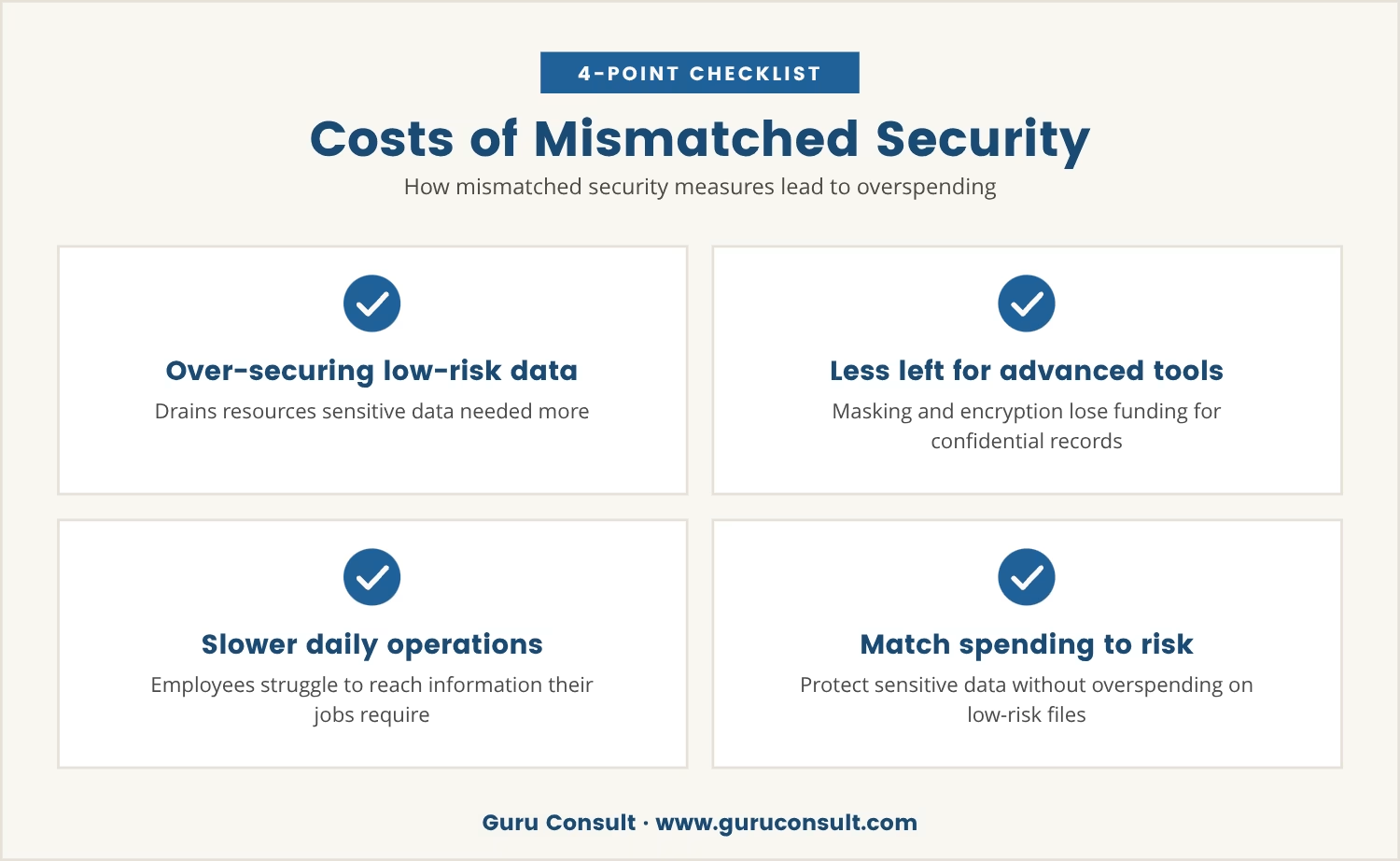
Protecting every piece of data at the highest possible level sounds like the safe move, but it rarely survives contact with a real budget. Over-securing low-risk information consumes resources that sensitive data needs more.
Once too much goes toward shielding public or internal files, less remains for advanced tools like data masking or encryption on confidential and regulated records. The imbalance doesn't stop at cost, either: it slows teams down, making ordinary work harder when employees can't reach the information their jobs require.
The fix is matching security investment to the actual risk level of each data type, so sensitive information gets protected without burning money or effort on files that never needed the extra layer.
Since a one-size-fits-all approach keeps failing for the reasons above, the alternative is a layered defense that flexes with each type of data a business holds. A few practical steps make that shift concrete:
Pulling these steps together, a tailored approach to data security guards against both overspending and under-protecting at once. Matching defenses to real risk makes it harder for attackers to find a weak spot, and it puts resources exactly where they do the most good.
For anyone who hasn't reviewed their data security practices recently, the question worth asking is simple: which types of data in the business are getting the right level of protection, and which ones are falling short?
Once the unique needs of each data type are understood, the result is a security system that keeps the business safe, efficient, and compliant, without wasting time or money along the way.

If your business has 15 to 200 employees, you may be unsure whether your current security setup truly fits the different types of data you handle. At Guru Consult, we know that many teams are stuck either overspending or leaving gaps in their defenses.
We invite you to see how our approach can help you focus your efforts where they matter most. Let’s talk about your specific data security needs and how you can protect what’s most valuable.
We’ll buy out your current IT contract for up to 3 months if you qualify, so you can upgrade your data security without waiting.
List every piece of information the company collects, stores, or processes, including customer records, employee files, financial documents, emails, and marketing materials. Group them by who uses them and how sensitive they are, consulting IT or security staff if the classification isn't obvious.
Treating all data the same leaves sensitive information like personal data or payment details exposed, which can lead to breaches, legal penalties, and lost customer trust. Attackers target the weakest link, so skipping extra protection on high-risk data raises the odds of a serious incident.
Direct the security budget toward what matters most: encryption and access controls for confidential and regulated data, basic protections and routine monitoring for everything else. Reviewing security policies regularly keeps spending aligned with actual risk.
Data masking replaces sensitive information with fake but realistic substitutes, which is useful when sharing data for testing or training without exposing real personal details. It fits situations where employees or partners need access to the data's structure but not the actual contents.
Different data types draw different threats: public data gets used for phishing, while confidential or regulated data is targeted for financial gain or identity theft. Matching security tools and policies to each data type's specific risk is what makes the defense effective.

Jason Huebner is the President of GURU and an eleven-year veteran of the company, having risen through the ranks by consistently delivering results and building strong relationships.
Reliable IT support for businesses with 15+ employees across Rockville and the DMV, guided by experts who actually know their stuff.
Enjoy your first month free with zero onboarding fees.