
Reliable IT support for businesses with 15+ employees across Rockville and the DMV, guided by experts who actually know their stuff.
Enjoy your first month free with zero onboarding fees.
When a co-managed IT partner is added without redefining internal roles, the in-house team’s skills can quietly decline as routine problem-solving shifts outward. This leaves the business with less internal judgment to rely on during a crisis, even though daily support may seem smoother.
When an internal IT team stops handling its own daily problems, the cost rarely shows up right away — it shows up later, in a crisis, as slower response times, fumbled escalations, and decisions made without the muscle memory to make them well.
That delayed cost is easy to overlook because the arrangement that causes it looks, on the surface, like pure gain. Co-managed IT services are brought in to strengthen internal IT teams, adding support and specialized expertise without asking anyone to give anything up. Plenty of businesses in Maryland use this model for exactly that reason: it lets them keep pace with growing technology demands while still holding onto control of their own systems.
The trade-off hides in the details of daily work. When routine troubleshooting shifts to an outside partner, the in-house team's day-to-day problem-solving fades quietly into the background, and because the shift happens gradually, it is easy to miss until it has already reshaped how confident and ready that team feels.
The mechanics of a co-managed setup are simple enough: the internal IT department works alongside an external provider, who fills gaps, absorbs workload, and supplies skills the internal team may lack. Yet unless the roles on both sides are deliberately rethought to fit the new arrangement, a business can end up trading away more than it meant to.

Bringing in a co-managed partner changes more than the ticket queue. Tasks the internal team used to own outright — troubleshooting, patching, fielding help desk requests — start getting shared or routed elsewhere, and for a team that was already stretched thin, that shift can feel like pure relief at first.
The relief, though, comes with a cost that builds slowly. As the partner absorbs more of the daily issues, the internal team's exposure to routine problems drops with it, which means less practice with the basics and fewer repetitions through which judgment normally gets built.
None of this shows up immediately. The team looks less stressed, more available for bigger projects, even as the steady loss of hands-on problem-solving quietly wears down their skills underneath that calm surface. Then a real crisis arrives, and the sharp instincts and recent experience needed to respond fast simply aren't there.
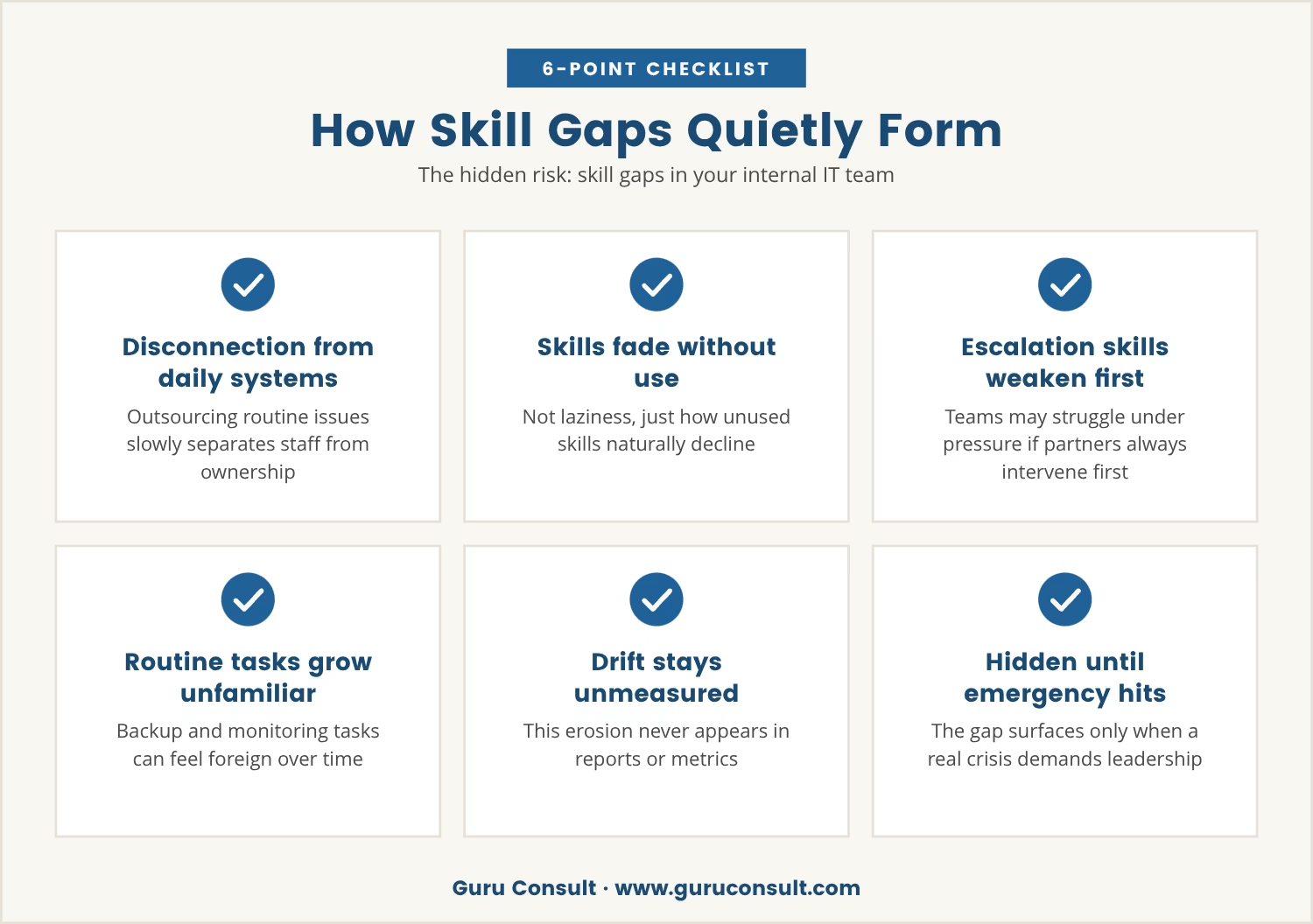
That instinct gap traces back to a simple mechanism: relying on outside help for everyday issues slowly disconnects the internal team from the systems they're supposed to own. It isn't a matter of laziness — it's just how skills behave when they stop being exercised regularly.
Consider a team that rarely handles escalations because the partner always steps in first; under real pressure, they may struggle to troubleshoot effectively. Push that further over time, and even routine tasks like data backup or proactive monitoring start to feel unfamiliar.
Because this drift is gradual, it never shows up in a report or a metric. It stays invisible right up until a genuine emergency forces the team to lead a response they haven't practiced for.
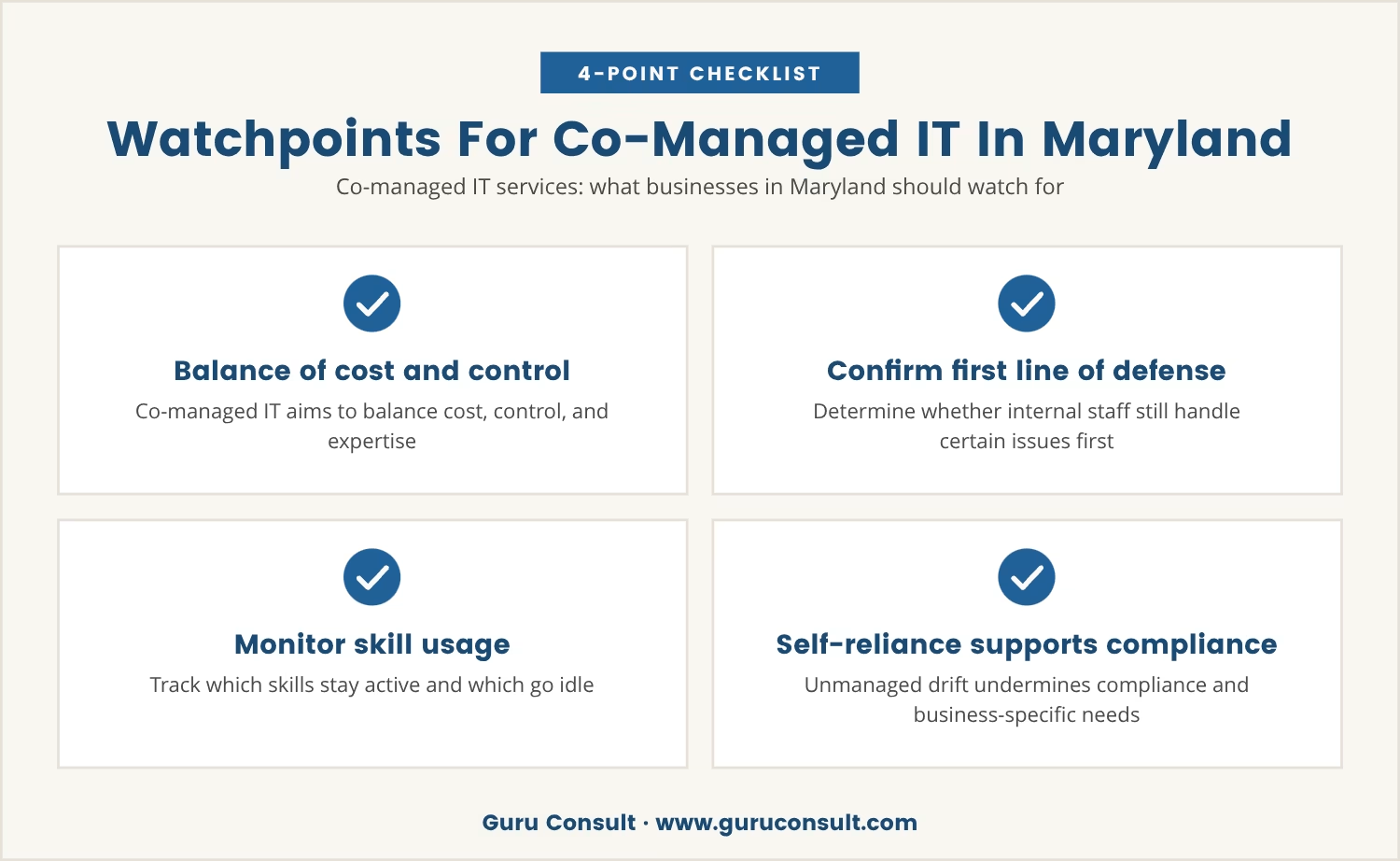
That same invisibility is exactly what businesses in Maryland need to plan against. Co-managed IT services are often chosen there to balance cost, control, and expertise at once, and the model can deliver all three — but only when the division of responsibility is actively managed rather than left to drift.
For a business in Rockville, or anywhere else in the state, the question worth asking is how daily work has actually changed since the partner came on. Is the internal team still the first line of defense for certain issues, or has that line already moved? Is anyone tracking which skills the team still uses regularly, and which ones have quietly gone idle?
Left unmanaged, that drift makes the internal team progressively less self-reliant, and self-reliance is exactly what local compliance needs and business-specific requirements depend on — the things only that team fully understands.
Skill drift doesn't arrive all at once; it takes root in specific corners of the operation, and spotting those corners early is most of the battle.
When the partner handles most user tickets, the internal team loses regular contact with end users and their everyday issues. That distance weakens troubleshooting instincts faster than most teams expect.
Once a partner takes over routine patching, the internal team can lose track of update cycles and the system dependencies tied to them.
When outside experts always handle security alerts, the internal team misses the repetition needed to build fast judgment for early threat detection.
If the partner leads every recovery test, the internal team may not actually know the steps or tools involved once a real incident hits.
When documentation lives externally, the internal team can fall behind on changes, which breeds confusion during outages.
If the partner negotiates with vendors directly, the internal team gradually loses touch with contract terms and support processes.
When every escalation goes outside, the internal team never builds the confidence or technical depth needed to handle tough problems alone.
Fortunately, none of this is inevitable — outside support and a capable in-house team can coexist, provided the arrangement is planned rather than left to default. A few concrete steps make the difference:
These same stakes are what make the choice between co-managed and fully managed IT service models matter beyond cost or convenience — the structure chosen here shapes a team's long-term capability, not just its monthly workload.
A fully managed approach has the provider handling nearly everything, often shrinking the internal team's role or shifting it elsewhere entirely. A co-managed setup is built on the opposite premise — team and partner working side by side — but without firm boundaries, that line blurs fast, and skills can erode there just as quickly as under a fully managed service.
What separates the two, ultimately, is control. Co-managed models let a business retain control and keep its team genuinely involved, but only with intentional effort; without it, the very strengths the business meant to protect are the first things lost.
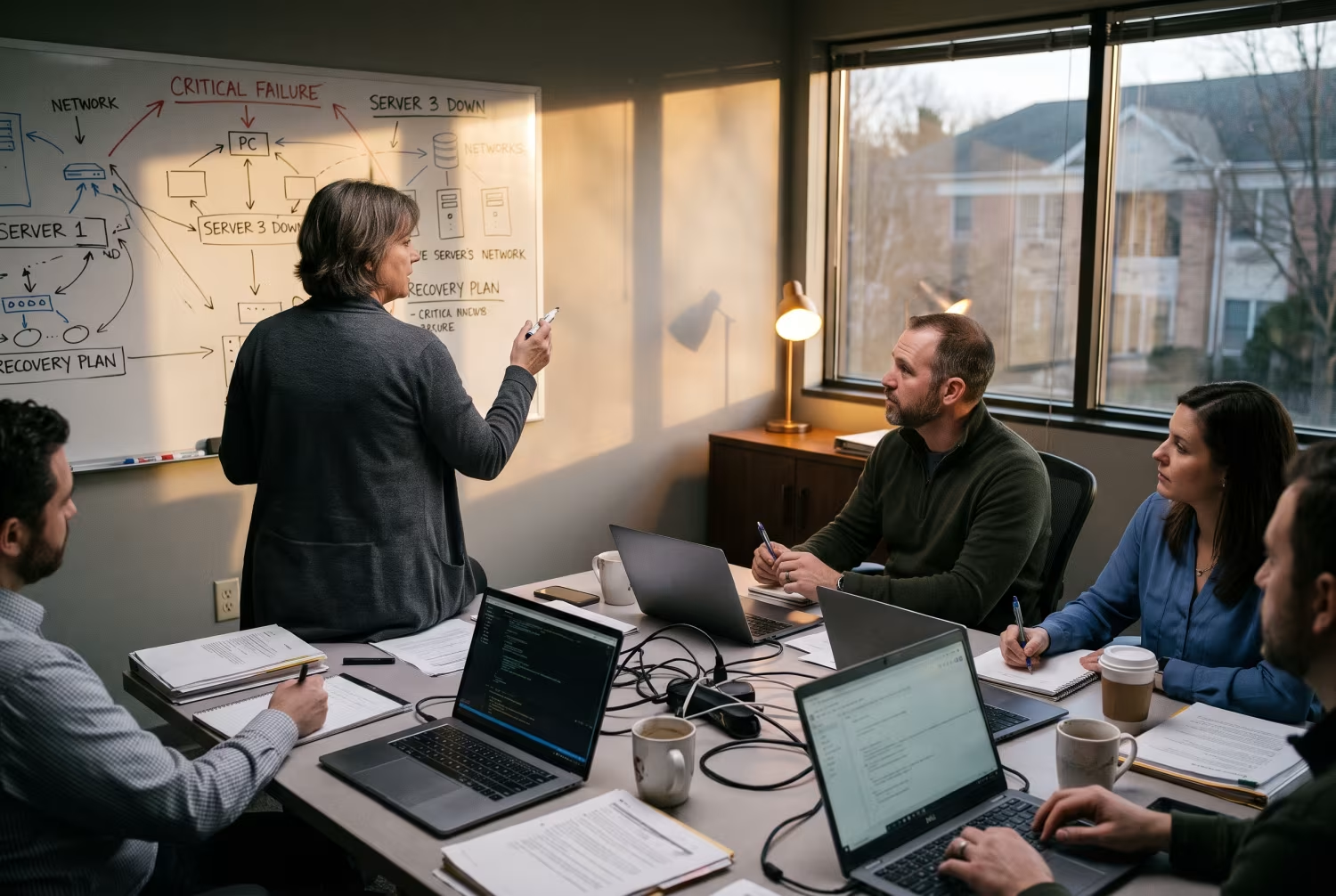
All of this erosion points toward one moment that matters most: the crisis itself. When a major outage or security incident hits, the internal team is often expected to lead the response — yet if they haven't been solving problems day-to-day, their judgment and confidence may not be ready for that moment.
This goes beyond technical know-how. It comes down to knowing the business, its systems, and its people well enough to make hard calls under pressure, and a team that's spent months on the sidelines is more likely to hesitate or stumble where a practiced team would not.
Keeping an internal team genuinely ready, then, means keeping them active, involved, and learning continuously — regardless of how much outside support sits alongside them.
If your business has 15 to 200 employees, you may be weighing how to balance outside IT help with keeping your own team strong. At Guru Consult, we understand how easy it is for internal skills to slip when a partner steps in.
We invite you to see how we approach co-managed partnerships—so your team stays sharp, involved, and ready for anything. Let’s talk about your unique setup and what would work best for you.
We’ll buy out your current IT contract for up to 3 months if you qualify, so you can switch without waiting and keep your team’s skills active.
Set clear boundaries for which tasks the internal IT team continues to own, and rotate responsibilities so the team stays involved in daily support, patching, and incident response. Regular training and joint exercises with the partner keep everyone's skills current.
Co-managed IT support means the internal team works alongside an external provider, sharing responsibilities between them. Fully managed services hand over nearly all IT tasks to the provider, which typically reduces the internal team's direct involvement, so the co-managed model preserves more control but demands active management to avoid skill loss.
Watch for fewer support tickets handled internally, reduced involvement in disaster recovery drills, or hesitation during escalations. When key tasks aren't being practiced regularly, skills tend to fade quietly, so regular reviews and candid conversations help catch the trend early.
A managed services provider can support a team's growth when the partnership is structured thoughtfully, including the internal team in troubleshooting, documentation, and training sessions. That way the team gains outside expertise without losing its own hands-on experience.
Ask how the partner plans to work alongside the internal team and what specific steps prevent skill gaps from forming. Find out how responsibilities are divided, how escalation works, and what training opportunities exist — a strong partner keeps the internal team capable, not just the gaps filled.

Jason Huebner is the President of GURU and an eleven-year veteran of the company, having risen through the ranks by consistently delivering results and building strong relationships.
Reliable IT support for businesses with 15+ employees across Rockville and the DMV, guided by experts who actually know their stuff.
Enjoy your first month free with zero onboarding fees.